Summary
Before we can understand what makes blues harmony special, we first need to understand the rules it bends. In this lesson, we harmonize the C major scale, introduce the number system, look at the roles of the I, IV and V chords, and establish a simple way of relating more complex chords back to basic triads.
Numbers vs. Roman Numerals
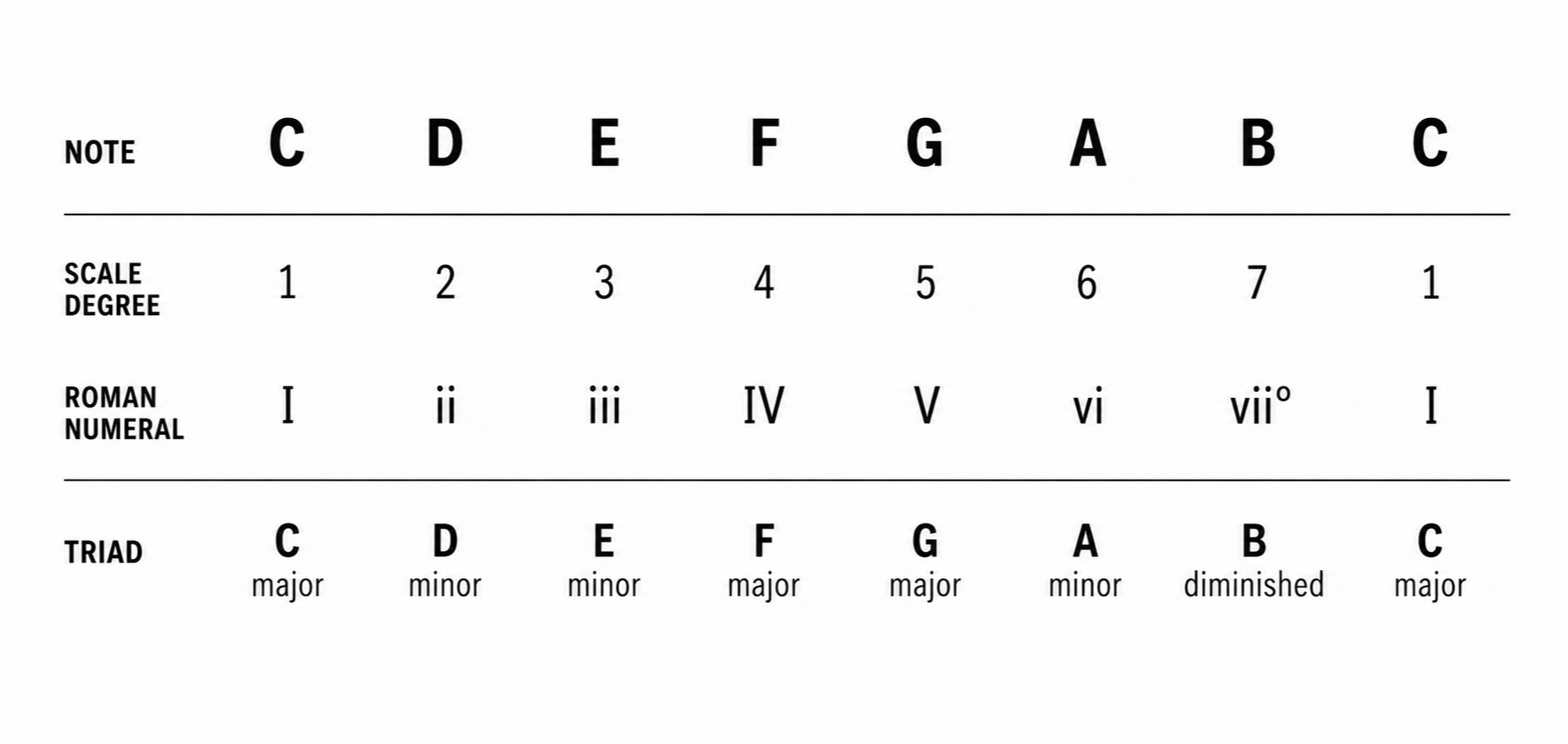
Regular numbers tell us the scale degree or position of a chord within the key. Roman numerals give us the same information while also showing the chord quality.
1 – 2 – 3 – 4 – 5 – 6 – 7
I – ii – iii – IV – V – vi – vii°
Uppercase Roman numerals indicate major chords.
Lowercase Roman numerals indicate minor chords.
A small ° indicates a diminished chord.
An augmented chord is written with a + or sometimes aug.
So in a major key:
1 = I = Major
2 = ii = minor
3 = iii = minor
4 = IV = Major
5 = V = Major
6 = vi = minor
7 = vii° = diminished
This system lets us talk about chord relationships without being tied to a specific key.
Note: When teaching, I’ll often switch between numbers and Roman numerals depending on the audience. I still recommend memorizing the basic relationships above so you can more easily follow other lessons, books, and reference materials.
Key Takeaways
- Harmonizing a scale means building a chord from each note of that scale.
- Triads can be created with a simple play a note → skip a note → play a note → skip a note → play a note pattern.
- In a major key, the diatonic triads always follow the same pattern:
Major – minor – minor – Major – Major – minor – diminished - The number system lets us describe chords by their position in the key rather than by specific chord names.
- Diatonic simply means that a note or chord belongs to the scale or key we're working with.
- The I chord is home (tonic), the V creates the strongest pull back home (dominant), and the IV creates a softer sense of movement (subdominant).
- The I, IV and V are all major triads in a major key—an important clue for understanding why the basic blues progression works.
- Rule of Reduction: more complex chords can be reduced to their underlying triads. This gives us a simple way to understand the harmonic foundation beneath a blues progression.
Vocabulary
Harmonize a Scale
Build chords from each scale degree using notes contained in the scale.
Diatonic
Belonging to the current scale or key.
Tonic
The I chord = our sense of home.
Dominant
The V chord = the strongest pull away from and back toward the tonic.
Subdominant
The IV chord = a weaker sense of motion than the dominant, but still an important departure from home.
Rule of Reduction
A complex chord can be understood by reducing it to its underlying triad.